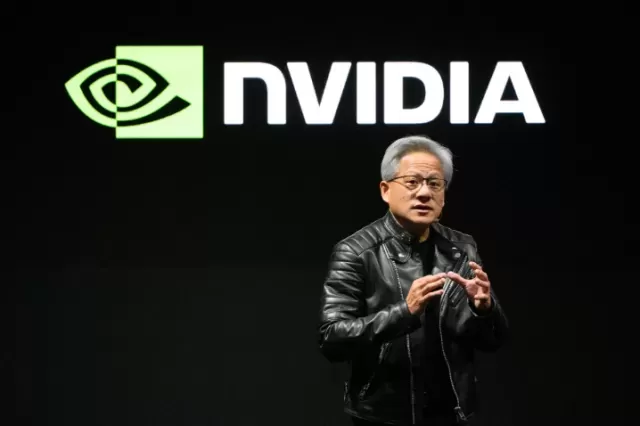
Nvidia Stock Dips Amidst Competition and Slowdown Fears
Nvidia's recent earnings report showcased impressive financial performance, with revenue surging and a promising forecast for continued growth. CEO Jensen Huang highlighted an unprecedented surge in demand for computing power, painting a picture of robust expansion for the chip giant.
However, despite these positive indicators, market sentiment has shifted, leading to a notable stock decline. Following a second consecutive day of losses on Friday, Nvidia's shares experienced their most significant weekly pullback since November, erasing earlier gains and moving into negative territory for the year, mirroring a trend observed across other major tech companies.
Several factors are contributing to this investor apprehension. A primary concern is the potential for capital expenditures among major tech firms to reach a peak. This suggests that Nvidia's current high growth trajectory might decelerate in the upcoming quarters and years. Furthermore, competition is intensifying. Companies that are substantial consumers of AI chips are increasingly exploring alternatives to Nvidia's dominant graphics processing units (GPUs).
A significant development highlighting this trend emerged on Friday when OpenAI, a long-time heavy user of Nvidia GPUs for AI model development and operation, announced a substantial commitment to utilize Amazon Web Services' Trainium AI chips. This agreement involves the consumption of 2 gigawatts of computing capacity. The announcement coincides with OpenAI securing a massive $110 billion funding round, with Amazon contributing $50 billion and Nvidia investing $30 billion.
Industry analysts, like Patrick Moorhead of Moor Insights and Strategy, view this move as a crucial validation of Amazon's in-house AI silicon strategy. It provides OpenAI with a vital hedge against potential supply chain issues and pricing pressures from Nvidia. This is not the first instance of OpenAI diversifying its chip strategy; the company also committed last month to adopting computing power from smaller AI chipmaker Cerebras, securing 750 megawatts.
It's important to note that OpenAI remains a significant Nvidia customer. The company confirmed on Friday that it will still leverage 5 gigawatts of computing power from Nvidia's upcoming Vera Rubin GPUs. This is in addition to their ongoing use of existing Nvidia GPUs across cloud platforms operated by CoreWeave, Microsoft, and Oracle.
While Nvidia reported a 73% year-over-year revenue increase to $68 billion for the January quarter and projected 77% growth for the current quarter, which would be the fastest expansion rate in a year, the long-term outlook suggests a slowdown. Following an anticipated 65% growth for the current fiscal year, analysts predict growth rates to moderate to 30%, 13%, and 14% in the subsequent three fiscal years, respectively.
Other tech giants are also pursuing Nvidia alternatives. Meta, for instance, announced on Tuesday that it will utilize up to 6 gigawatts of Advanced Micro Devices' Instinct GPUs. Reports from Thursday also indicate that Meta has entered into a multi-billion dollar agreement to use Google's Tensor Processing Units. This diversification strategy by major AI players signals a growing market for custom silicon and alternative GPU solutions.
Broadcom, a company involved in developing custom chips for Google, saw its stock decline by approximately 4% for the week. The company is slated to release its fiscal first-quarter earnings on Wednesday, and market participants will be watching closely for any insights into its performance and future outlook.
Despite the recent downturn, Nvidia's 5% year-to-date decline is being viewed by some analysts as a potential buying opportunity. Some see this as a chance to acquire shares at a more attractive valuation, anticipating a future market rotation back towards AI-focused companies. Analysts at Jefferies, who maintain a buy recommendation on Nvidia's stock, believe that while the timing remains uncertain, the stock's decreasing price presents a compelling entry point. They express confidence in a eventual shift in investor sentiment that will lead to a resurgence in demand for AI stocks.